We’re working our way out of the January Big Chill, temperatures below zero since sometime Saturday. But the sun is out, the wind has settled and after 25+ years of living with horses, I’ve amassed an ample stash of unattractive but utilitarian cold weather clothing.
I’ve accumulated an assortment of head bands, stocking caps and an ear-flapped Elmer Fudd hat, neck gaiters, a balaclava, wool socks, winter boots, and insulated everything from underwear to overcoats.
So, I gear up and waddle to the barn, where I get my chores done in a finely honed routine that minimizes exposure to the worst of winter weather.
The single chink in my arctic armor is that although I’ve invested a mountain of money to keep some heat in my hands – silk liners, down mittens, fleece gloves, leather choppers, air-activated, battery-powered and rechargeable hand warmers – I have not yet found a surefire solution to freezing my fingertips.
But that’s what warm(ish) tack rooms are for, so when I lose my hold on the handle of the manure fork, I find Fennel in the heated shop to defrost my digits in his winter-fattened fur for a few minutes.
Our barn opens to a south-facing covered shelter, remarkably toasty, protected from the wind, heated by the sun, and both horses seem content to hang out there much of the day, wandering into the pasture for brief cooldowns when the solar power gets too intense.
Even at 7:00 pm, 2 hours before my usual night check, when it’s twenty below, my time-honored limit for leaving horses outside, I slide open the big door to see Chicago and Moe standing quietly, with plenty of hay leftover from the 4:00 feeding. They’re calm, no shivering, no pacing, no hunched posture, just standing quietly. Waiting? Wondering? Watching the world go by in the woods?
They assess as I, and more importantly, my freshly filled wheelbarrow, assume our positions in the doorway, then move to their places, Chicago at the west side feeder, Moe front and center, grazing directly from the source. They’re built for this.
They demonstrate no distress, in part, I suppose, because I give them more hay (the fuel that keeps their furnaces fired up) than they can consume, which means they get to pick through for their favorite forages, go back through for seconds and thirds, then pee on the remnants just before I come down to re-stock.
Chicago and Moe are more compatible companions than bonded buddies, spending some of their days in separate parts of the pasture, but mostly they hang together in the shelter keeping each other company and keeping each other warm.
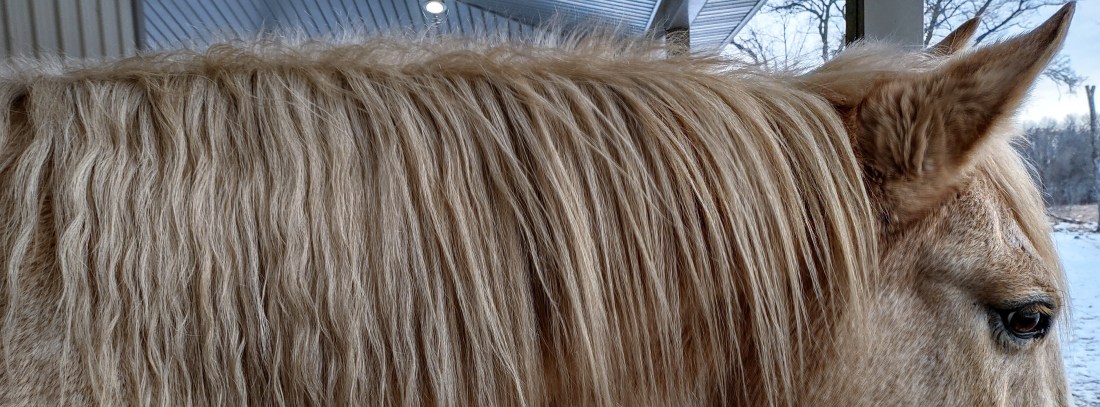
They’re also sporting their hi-test teddy bear plush this winter. Because 2024 was unusually mild, Moe’s cold tolerance was never tested, so I wasn’t sure where his internal thermostat is set.
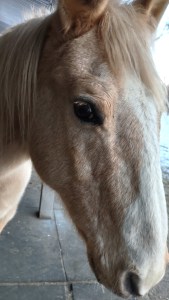
Turns out, he’s a polar pony, showing no sign of discomfort outside, and a definite preference for the wide-open spaces of barn’s backyard to the 10 x 12 confines of a stall in the stable.
In this second year together, my yellow spotted gelding is yielding to the idea that he’s with us for the long haul, that’s this is an ok place to be, and that we’re an ok crew to be with.
He now pauses in the open stall door to accept an extra apple treat or a (very) quick muzzle nuzzle before heading out to his afternoon snack session.
When I go out to take his picture, he follows me around so closely that I can’t capture him on my camera because he moves every time I do, his fuzzy nose on my frozen hand just as I tap the shutter button, which means I have almost no Moe photos that don’t include my left index finger alongside his right nostril.
He loiters in front of the wide sliding door while I churn through chores, luring me over to lavish him with a little mittened neck massage, and this is where I find my favorite hand heater.
The neck under a horse’s mane is blissfully balmy and there is no better way to warm up on a wintry day than to stand in the sunny shelter, hands hidden in a horse’s hair, soaking up all that equine essence.
The biggest banes to Moe’s existence these days are the dogs, at whom he pins his ears when they dawdle as they pass through the shelter to the pasture.
Ruffian recently watched Moe trot toward the barn and started making his way into the merriment until Moe whirled around to clarify the NO CANINES canon. I’m not sure if he was driven by good sense or simple survival instinct, but Ruff was impressed enough by the display of strong, speedy suppleness to stay on his own side of the fence.
Moe may be missing one eye and some strength in his hind end, but his communication skills are still intact.
As is his always available natural handwarmer.
 From Four Sticks Farm